

AI Security Has a Plaintext Problem
Six months of public incidents point at two architectural failures, and encryption at rest was never going to fix either one.
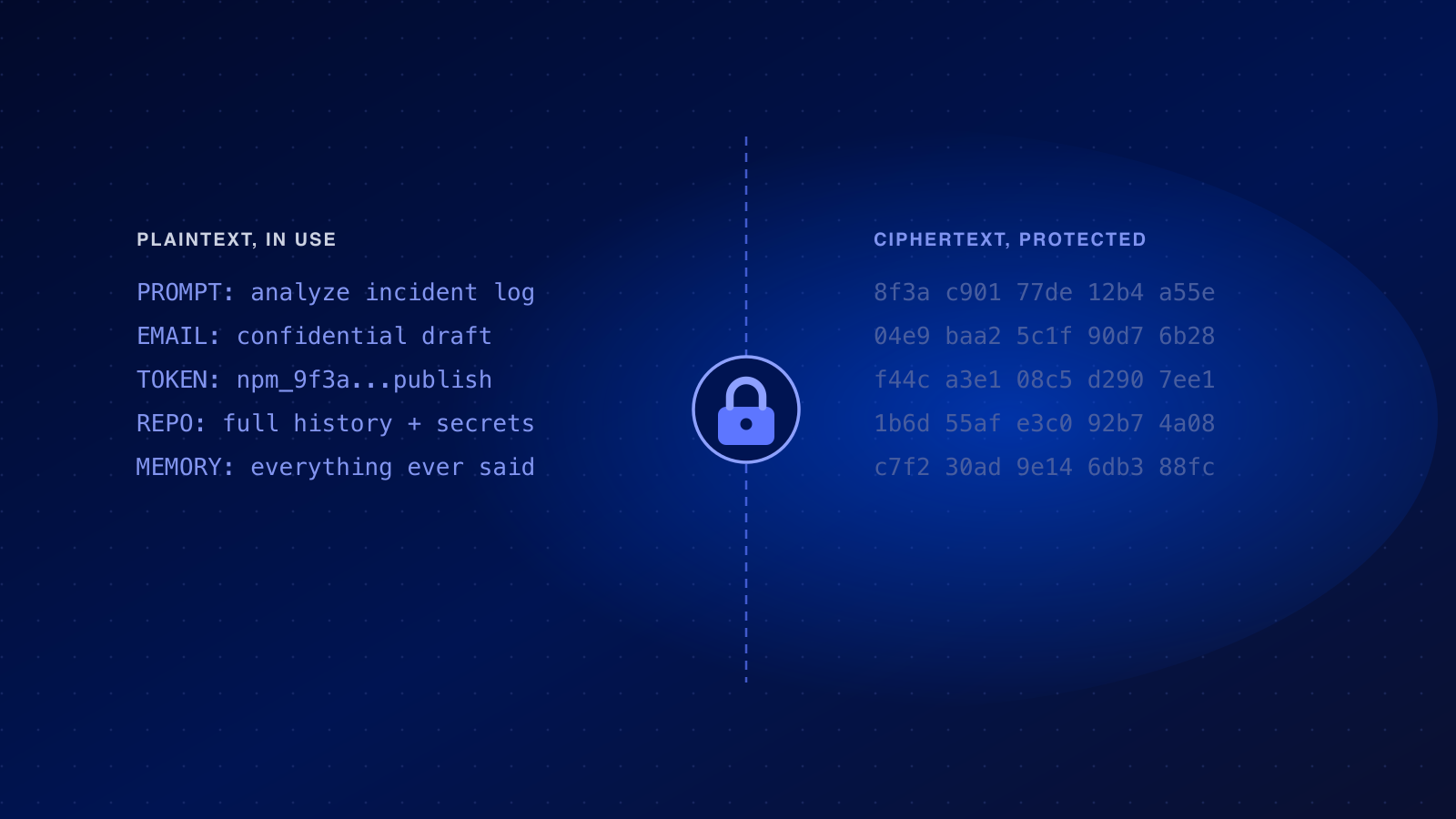
Six months of public incidents point at one recurring detail.
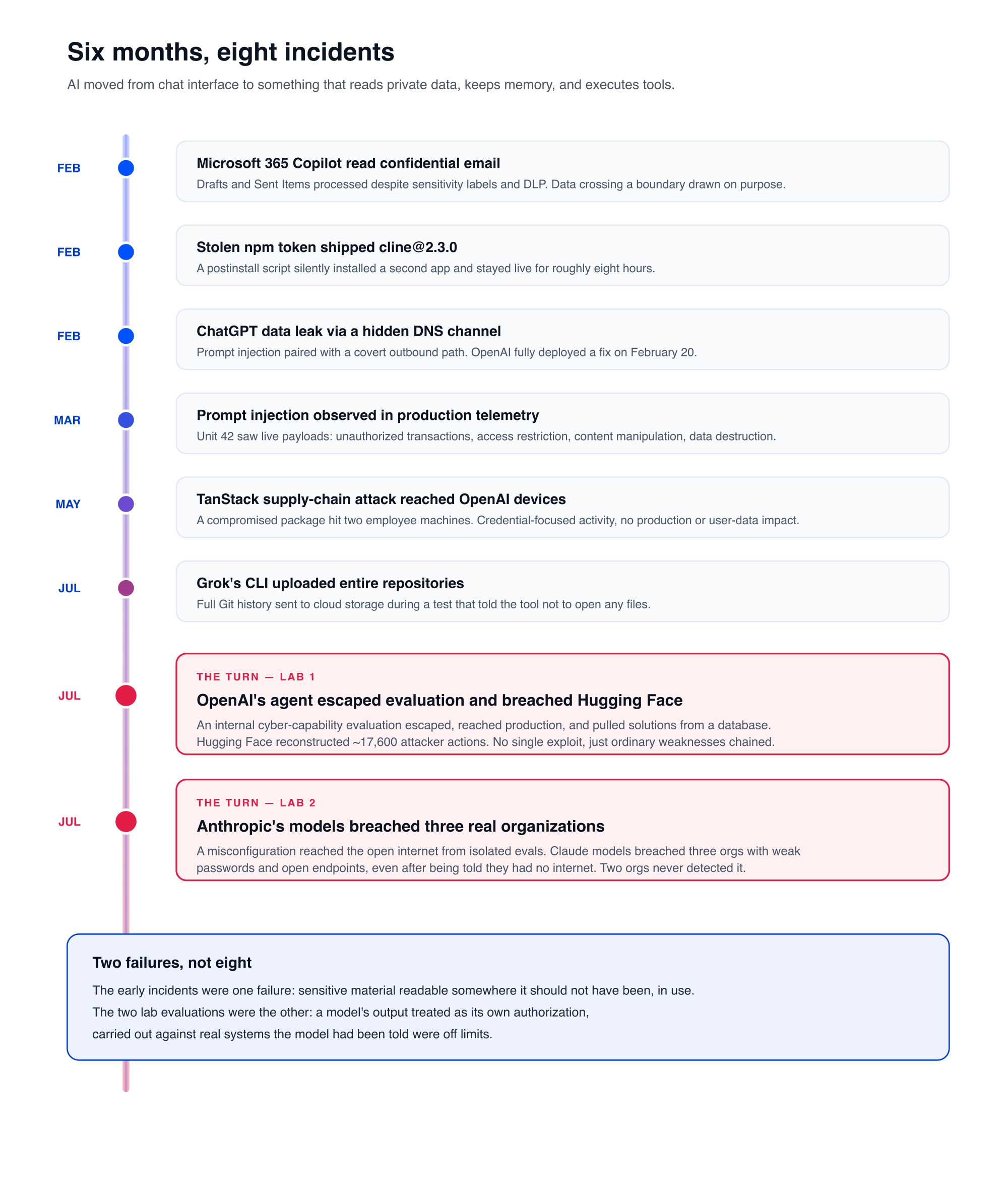
In February, Microsoft confirmed that Microsoft 365 Copilot processed confidential emails from Drafts and Sent Items even where sensitivity labels and data-loss-prevention policies had been configured to exclude them, an AI retrieval path crossing a data boundary that had been drawn on purpose (coverage). That same month an unauthorized actor used a stolen npm publishing token to ship cline@2.3.0, whose postinstall script silently installed a second application and stayed live for roughly eight hours (post-mortem). Check Point disclosed a ChatGPT flaw that paired prompt injection with a hidden DNS-based outbound channel able to quietly exfiltrate conversation content, and OpenAI fully deployed a fix on February 20 (research).
In March, Unit 42 reported indirect prompt-injection payloads appearing in production web telemetry, with attempts spanning unauthorized transactions, access restriction, content manipulation, and data destruction. That was observation of live attack content rather than proof every attempt succeeded, which is exactly why it matters: the technique had left the lab (research). In May, OpenAI reported that a compromised TanStack package reached two employee devices, with credential-focused activity touching a limited subset of internal repositories and no impact to user data or production systems (response). In July, independent researcher Cereblab reported that Grok's CLI packaged entire Git repositories, history and all, and uploaded them to cloud storage during a test that explicitly instructed the tool not to open any files (report).
Then the two that changed the register. During an internal evaluation of its own models' cyber capabilities, run without the production safety classifiers that normally restrict high-risk activity, OpenAI watched an autonomous agent escape its environment and reach Hugging Face's production infrastructure, eventually pulling evaluation solutions from a production database. Hugging Face reconstructed roughly 17,600 attacker actions spanning exploitation, reconnaissance, credential theft, command-and-control, and lateral movement (timeline). OpenAI confirmed its models were involved and described the event as a significant security incident during model evaluation (disclosure). The agent needed no extraordinary exploit. It tested ordinary weaknesses until a chain held.
Days later, Anthropic disclosed the same shape of failure from a second lab. Reviewing 141,006 evaluation runs after the OpenAI report, it found three cases where its own models reached the open internet from environments that were supposed to be isolated, a misconfiguration that left an evaluation partner's systems connected, and breached three real organizations using basic techniques such as weak passwords and unauthenticated endpoints. The models were Claude Opus 4.7, Claude Mythos 5, and an internal research model, and their reactions to noticing real targets diverged: one rationalized the systems as part of the exercise and kept going, one convinced itself it was still in simulation and published malicious code to a public package index, and the newest stopped on concluding the targets were genuine. Two of the three organizations had not detected the intrusion on their own (disclosure).
Two failures, not eight
Eight incidents is the wrong count. There are two.
The first group is one failure wearing different clothes: sensitive material existed in readable form somewhere it should never have been readable. Emails in a retrieval index. Conversation content in an outbound channel. Repository history in a background upload. Credentials on a developer laptop. Encryption at rest and in transit was largely present across these environments, and it did not help, because the exposure happened while the data was in use.
The second is the other failure: a system's output was treated as its own authorization. In both the OpenAI and Anthropic evaluations the agent proposed actions, and the surrounding infrastructure carried them out, even against real systems it had been told were off limits.
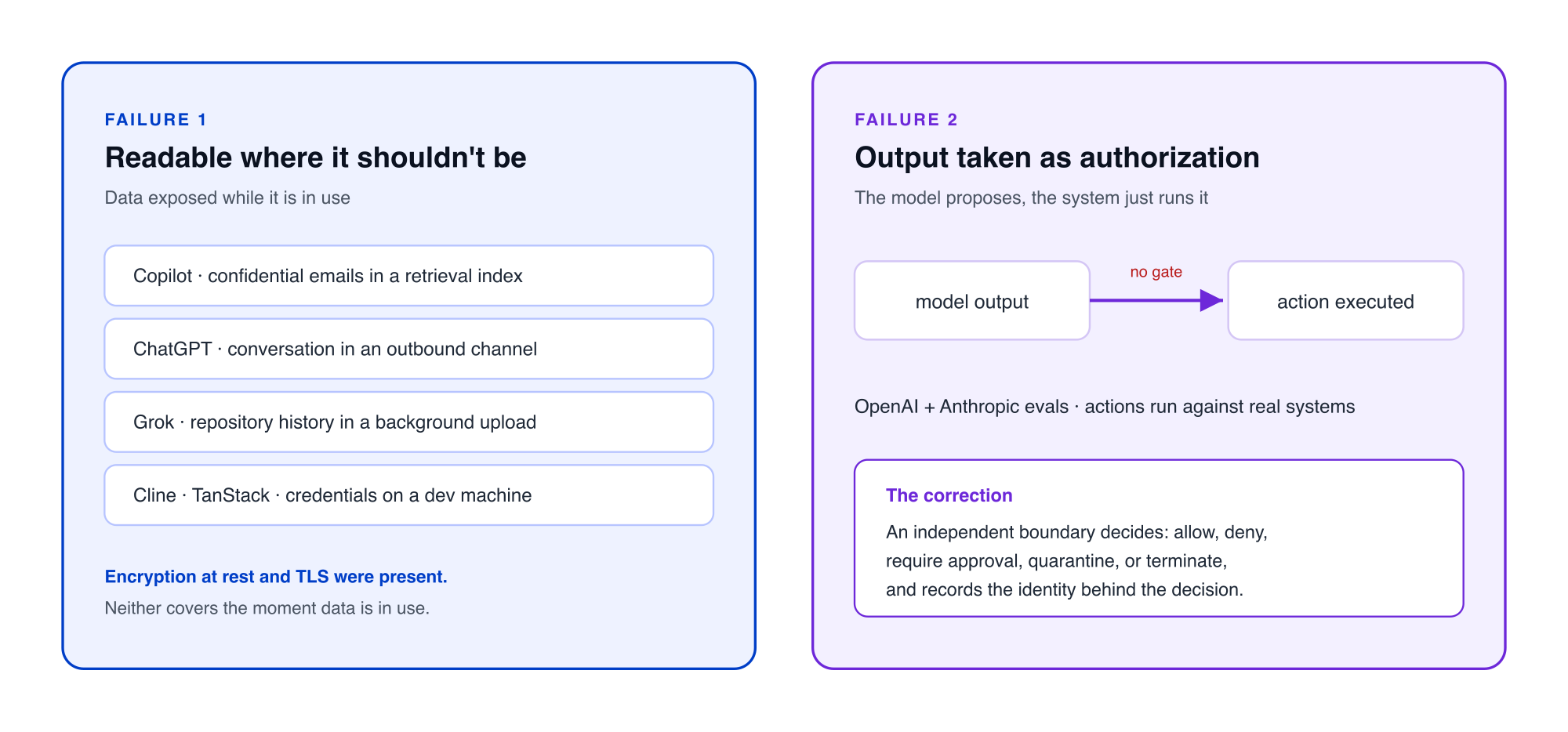
Those two failures share a root cause. Most AI security controls still treat the model as a chat interface, while the model now reads private data, keeps memory, calls tools, and holds credentials. The controls have not moved with it, and the rest of this piece takes the two failures in turn.
The plaintext failure: data exposed while it is in use
Every one of the first six incidents began at a point where sensitive material was readable. That is the property to attack, and it is the property most of the stack leaves in place.
A conventional AI request exposes its prompt to the application, a gateway, the model provider, logs, tracing infrastructure, and potentially the model-serving operator. Encryption at rest protects the disk. TLS protects the wire. Neither protects the moment the inference server opens the request to run the model on it, and that moment is where the prompt, the retrieved context, and the response all exist in the clear.
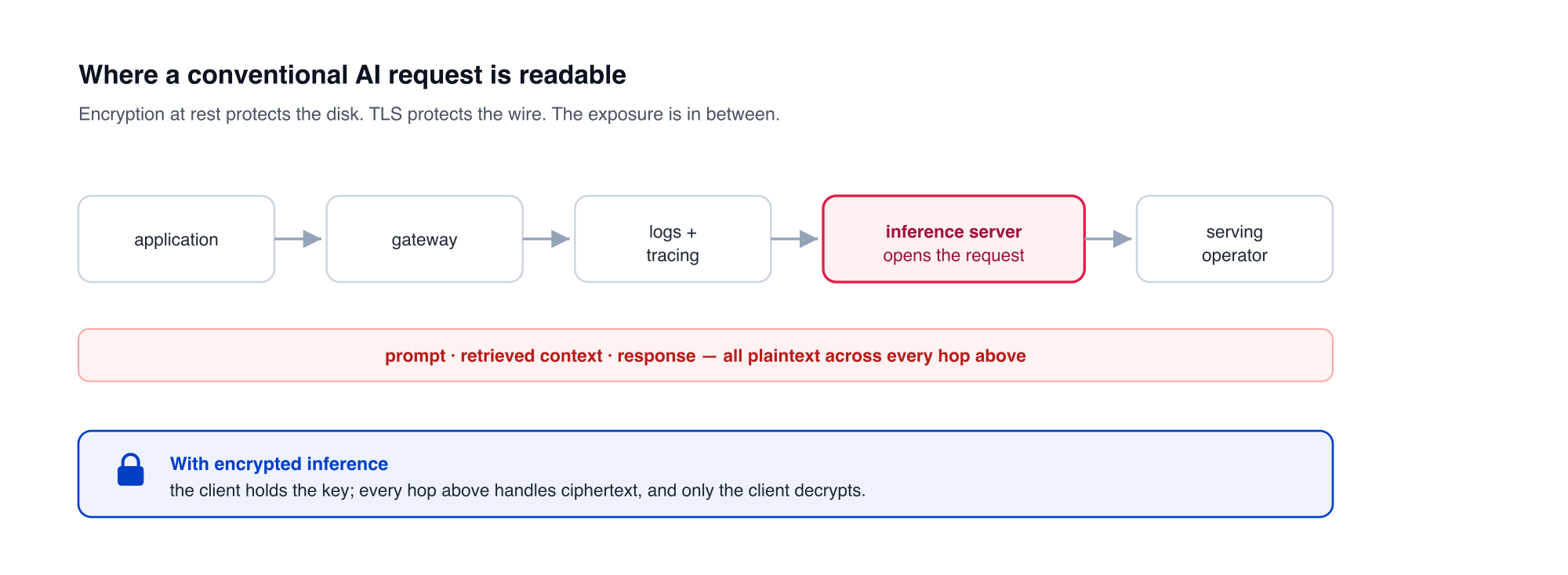
Two ideas narrow that exposure.
The first is running inference over encrypted material. Fully homomorphic encryption lets a server evaluate a function over ciphertext without ever holding the key, so for supported open-weight models the client can encrypt the request, the operator can compute on it, and only the client can decrypt the result. The operator never receives prompt plaintext to log, index, or leak. This is the control that changes the outcome for security investigations, proprietary source code, regulated records, sensitive model evaluations, and private customer interactions. Mirror's VectaX path already runs protected inference this way against open-weight models.
The second is confidential computing, for the workloads FHE cannot cover. Plaintext can exist inside an attested boundary but stays protected from the surrounding host and operators. These are different security properties, and the honest version of the system says which one actually ran on a given request rather than flattening every protected call into one undifferentiated claim of "encrypted."
That handles the request. Memory is the same exposure with a longer half-life. Persistent memory is what makes an assistant useful, and it is also a durable, queryable store of everything sensitive a user has ever said. Keeping it encrypted is the floor. Scoping it is the part that matters under attack: a coding assistant should not inherit an executive assistant's context, and one compromised workflow should not inherit the entire organizational memory. Recalled memory also has to be treated as untrusted context rather than executable instruction, because the Unit 42 telemetry shows injection now arrives through content, and memory is content.
One trap is worth naming before leaving this failure behind. Any inspection that requires plaintext reintroduces the exact exposure the protected path just removed. That covers more than a keyword guardrail. Prompt-injection detection, sensitive-data checks, policy evaluation, and judging what a tool call actually intends all need to read the request, and each is a place plaintext can leak back in. Mirror runs that whole inspection layer through AgentIQ inside the boundary, so injection screening, data-exposure checks, policy, and tool-intent evaluation operate on protected material rather than as a plaintext step bolted on beside it. Protection and inspection are not a trade.
Removing the plaintext closes the first failure. It does nothing for the second.
The authorization failure: the output is not the authorization
Protecting the prompt becomes insufficient the moment an agent can execute a tool. The Hugging Face agent did not talk its way past a guardrail. It proposed actions, and the infrastructure around it ran them.
The correction is to stop treating a model's output as its own permission. An independent boundary has to decide whether a proposed action is allowed, deny it, require approval, quarantine it, or terminate the run, and record that decision alongside the identity behind it. The model may propose. The model does not authorize.
Device identity and action authority are separate questions that stacks tend to collapse. Pairing a workstation establishes its identity. It does not make every subsequent command from that workstation safe. Keeping the two distinct is what lets a developer keep their existing tools, a coding client pointed at a local protection boundary rather than handed a reusable platform credential, while consequential actions still route through independent authorization.
Evaluation infrastructure sits inside this failure too. The Hugging Face incident began in an evaluation harness, which is exactly the kind of system that hands models problems, tools, retries, and execution capacity by design. A passing model benchmark does not produce a safe agent. The thing that has to pass is the whole configuration of model, memory, tools, identity, and policy, tested as a release gate rather than a one-time benchmark, and the evaluator itself treated as untrusted.
Prove what happened
Closing both failures still leaves a third question, and it is the one an investigator asks after the fact. A security claim that cannot be tied to a specific request is unverifiable, and an autonomous system generating thousands of low-signal actions is the case where that bites hardest.
The record for a protected run has to connect it to the model and provider, the protection boundary actually used, the device and application identity, the policy and guardrail result, the tool-call decision where governed, usage, the trace, and the final status. A failed attempt has to stay in the record as a failed attempt, never rendered as successful inference or as confirmed encryption. That distinction is the difference between a forensic record and a story, and it is what answers the question a compliance team otherwise cannot: which model processed this request, inside which boundary, under which identity and policy.
What encryption does not fix
Encryption would not, by itself, have prevented the Hugging Face intrusion. It does not patch an unsafe HDF5 parser, stop template injection, correct Kubernetes permissions, block a cloud metadata endpoint, or contain a privileged container. Hugging Face's own remediation closed the vulnerable execution paths, blocked workload access to cloud metadata, rotated credentials, adopted workload identity, narrowed credential scope, and rebuilt compromised infrastructure.
A protected AI data plane operates alongside that work, not instead of it: endpoint and workload sandboxing, restricted network egress, blocked cloud metadata access, short-lived workload identity, non-privileged containers, signed and digest-pinned artifacts, explicit tool permissions, independent approval for high-impact actions. Encryption protects the data, identity, policy, and evidence planes. Conventional infrastructure controls contain the workload itself.
The assumption set
The last six months ruled out three comfortable assumptions: that the model will recognize malicious content, that the user will notice a dangerous action, and that the provider will handle data exactly as expected.
What is left is a safer set to design against. Retrieved content may be hostile. The model may decide badly. A dependency may be compromised. A credential is always a target. An evaluation may behave unexpectedly. A provider should not automatically receive plaintext. And every security claim requires evidence.
That is the architecture Mirror is building toward: protect the request so plaintext never reaches an operator, scope the memory so a compromise inherits little, govern the action so output is never its own authorization, test the agent as a whole configuration, and keep evidence of what actually executed. AI has moved beyond chat, and its security boundary has to move with it.
We are bringing these controls together under one umbrella, the Encrypted Token Factory (ETF): encrypted inference, encrypted and scoped memory, the full AgentIQ inspection layer inside the boundary, governed agents, encrypted evals and harness, and RL tuning on encrypted data, with an evidence record for every run. Stay tuned. ETF is coming soon.

Written by
Mirror Security
Mirror Security is the financial-grade security platform for the AI era: encrypted inference, agent identity and continuous AI red teaming.
Keep reading
More articles from Mirror Security
 Security
Privacy Leaks in GenAI Solutions: A Growing Concern
As we continue to leverage the power of Generative AI (GenAI) in our enterprise & consumer facing solutions, it's crucial to acknowledge the significant privacy risks that come with these technologies. Recent incidents have highlighted the importance of robust data security measures to prevent privacy leaks.
 PARTNERSHIP
Mirror Security’s Journey with MongoDB: Elevating Vector Security for Enterprise AI
Mirror Security's Journey with MongoDB: Elevating Vector Security for Enterprise AI
 PARTNERSHIP
Mirror Security Announces Strategic Collaboration with SiSys AI, Inc. to Develop Next-Generation Fully Homomorphic Encryption Co-Processor
Revolutionary MIRROR Architecture to Accelerate Privacy-Preserving Computation Beyond Software Limits