

Mirror Security: 2025 Year in Review
The model crown changes weekly. Your data can't.
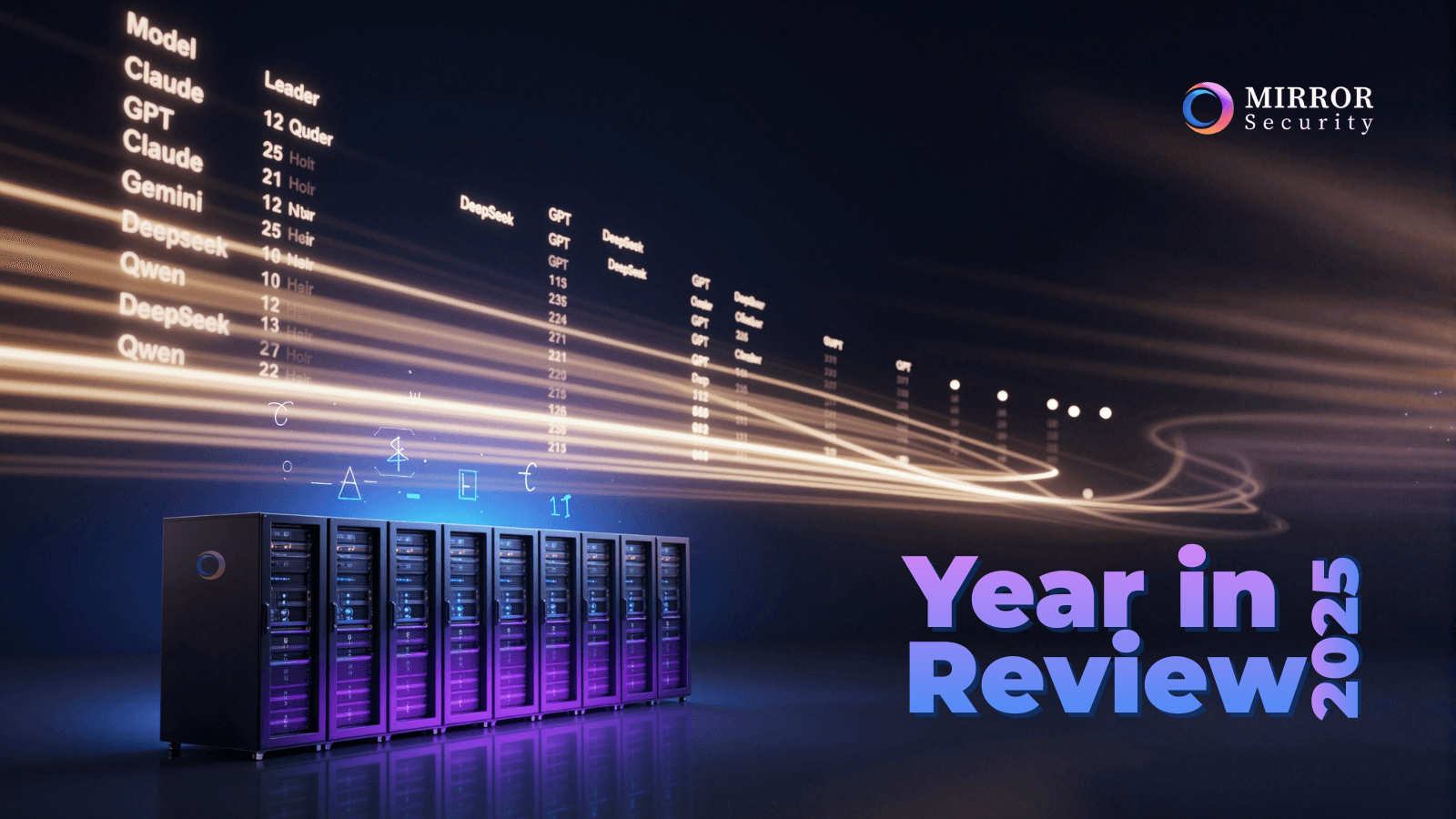
In 2025, the 'best model' rotated so fast it barely mattered: GPT-5, Claude, Gemini, DeepSeek, Qwen. Benchmarks shifted, leaderboards churned, and last month's breakthrough became this month's baseline.
Meanwhile, the real problem stayed the same:
How do you use AI on sensitive data, without leaking it to the provider, the operator, or the platform?
That's what we built.
Mirror Security is the infrastructure layer for private AI: private compute + policy enforcement + adversarial validation, all delivered through one gateway. It ships as four products: VectaX, AgentIQ, DiscoveR, and Code Prism.
The Core Idea: Private AI Should Be the Default
Most teams don't avoid AI because it's weak. They avoid it because it's risky.
Prompts contain a strategy. Documents contain deals. Code contains IP. Patient notes contain PHI. Client portfolios contain financial identity. 'Trust us' isn't a security model, especially when providers are high-value targets and regulations increasingly require provable controls.
Mirror Security is built for environments where data exposure isn't an acceptable tradeoff.
VectaX: Private Compute You Can Prove
Different teams have different threat models, so VectaX supports two paths.
Confidential AI
Runs models inside hardware-attested secure enclaves (Intel TDX / AMD SEV). The operator can't see inputs, and attestation proves the environment is genuine. Performance stays near-plaintext because computation happens inside a trusted boundary.
FHE Inference
Goes further: data stays encrypted even while the model computes. No plaintext to the provider, the operator, the hardware, or an attacker after compromising.
This is live today. On A100/L40S-class GPUs, we see production-grade encrypted throughput:
- 7B: ~90–180 tokens/sec, ~50–150ms to first token
- 70B: ~25–70 tokens/sec, ~120–300ms to first token
- MoE: up to 150–300 tokens/sec with sparse activation
Encrypted payloads stay <16KB each way, and client-side encryption adds ~2–5ms.
That's fast enough for interactive apps and agent workflows; encrypted end-to-end.
VectaX Encrypted Memory: Encrypted Retrieval, Real Context
Agents need memory. Most memory stacks leak.
VectaX keeps retrieval encrypted end-to-end with encrypted BM25 + encrypted vectors (a true inverted index over ciphertext). Hybrid retrieval hits p95 < 8ms with near-plaintext ranking quality (NDCG@5 ≈ 0.954). It behaves like a normal retrieval stack—without the index ever seeing plaintext.
The context layer handles failure modes that break real agents—temporal drift, numeric consistency, and missing coverage—so answers stay stable over time. Result: 98% top-1 accuracy on temporal and numeric questions, without prompt hacks.
AgentIQ: Enforceable Security for Agents
AgentIQ is policy enforcement for agents: signed actions, attestable execution, and 100+ controls that gate tools and data.
'Guardrails' are not agent security. They're a suggestion layer. In production, an agent is a security principal. It needs identity, constrained permissions, and an audit trail that stands up to scrutiny.
AgentIQ gives agents a cryptographic identity, signs tool calls, a trusted MCP server, and ties actions to verified execution environments—so actions are attributable and verifiable, not just logged. Then it enforces policy before tools run and before data leaves.
At the center is a deny-by-default policy engine with 100+ deployable policies and domain packs for finance, healthcare, enterprise IT, and privacy compliance. Decisions come back as allow/deny / monitor, with risk scoring and human-readable rationale.
Inline defences run fast enough for the hot path at ~50ms.
Decisions are enforceable, explainable, and reviewable.
DiscoveR: Prove It Survives Attack
DiscoveR is the difference between 'we think it's safe' and 'we can prove it survives attack.'
DiscoveR tests your actual deployment—tools, RAG, policies, agents, apps, and all—because that's what attackers target. It fingerprints the system first, then runs adversarial campaigns across jailbreaks, prompt injection, RAG poisoning, tool abuse, model extraction, and membership inference.
Under the hood: 60+ attack modes and 2,500+ prompts across 11 categories, with strategy selection and hierarchical judging to reduce wasted probes and false positives.
The output is straightforward: what broke, how it broke, and what to change—policy, retrieval, tool permissions, or model-layer defenses.
CodePrism: A Secure IDE Boundary
For many teams, code is the crown jewel.
Code Prism is a zero-trust coding assistant for VS Code where plaintext stays on the workstation, be it prompts, files, tool calls, responses, and telemetry. Providers see ciphertext.
But the differentiator isn't 'encrypted transport.' It's that Prism is an IDE boundary with the same security model as production agents: secrets controls, policy enforcement, tool approvals, MCP-aware validation, and auditable signed actions.
Developer speed shouldn't quietly become IP leakage.
One Platform: Mirror Gateway
VectaX, AgentIQ, Mirror Discover, and Code Prism aren't separate systems you stitch together.
They run through Mirror Gateway: identity, policy, encryption, routing, and audit—one integration point, uniform streaming, and single-digit millisecond overhead.
Choose confidential enclaves for near-plaintext performance. Choose FHE for maximal privacy. Add encrypted memory, enforce AgentIQ policies, and continuously validate with Discover. Same interface. Same guarantees. Same audit trail.
One integration. One policy plane. One audit trail. Private AI becomes the default.
Why This Matters
The 'best model' will keep changing. That's fine.
But your obligations don't change: protect sensitive data, prevent leakage, prove controls, and withstand adversarial pressure.
Mirror makes AI deployable where it actually counts: regulated, sensitive, high-stakes environments.
Not trust. Not promises. Guarantees—math, attestation, and enforcement.

Written by
Mirror Security
Mirror Security is the financial-grade security platform for the AI era: encrypted inference, agent identity and continuous AI red teaming.
Keep reading
More articles from Mirror Security
 PARTNERSHIP
Mirror Security’s Journey with MongoDB: Elevating Vector Security for Enterprise AI
Mirror Security's Journey with MongoDB: Elevating Vector Security for Enterprise AI
 Security
DeepSeek R1 & R1-Zero: A New Milestone in Language Model Reasoning & Safe AI Adoption
DeepSeek R1 & R1-Zero: A New Milestone in Language Model Reasoning & Safe AI Adoption
 Security
Sovereignty Without Verifiable Inference Is a Mirage
The sovereignty illusion